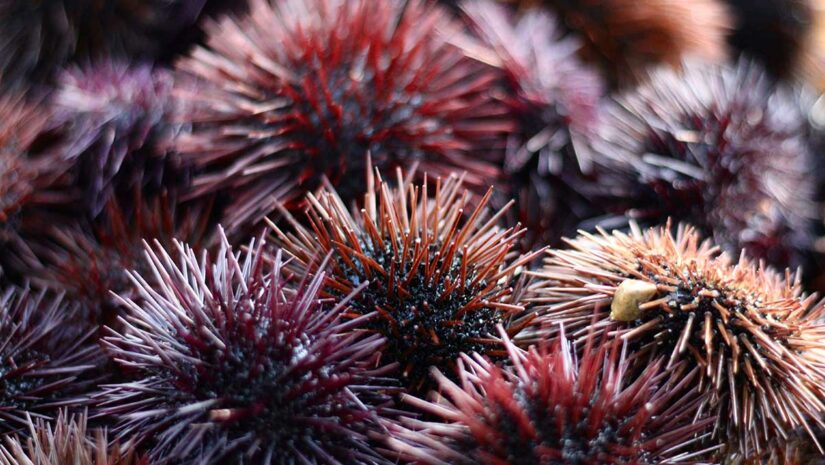
Sea urchins are some of the world’s most ubiquitous marine animals, as indeed, they can be found in nearly all corners of the planet’s oceans, as long as its main food source, algae, is present. They are also known to prey on other invertebrates, like mussels, sponges, brittle stars, and sea cucumbers, the last two of which are from the same phylum as the sea urchin: Echinodermata.
This group also includes starfish and sand dollars, and echinodermate is a Greek term that means spiny skin. All echinoderms share the characteristic of bi-lateral symmetry in their body composition, which becomes a five-fold symmetry as they mature.
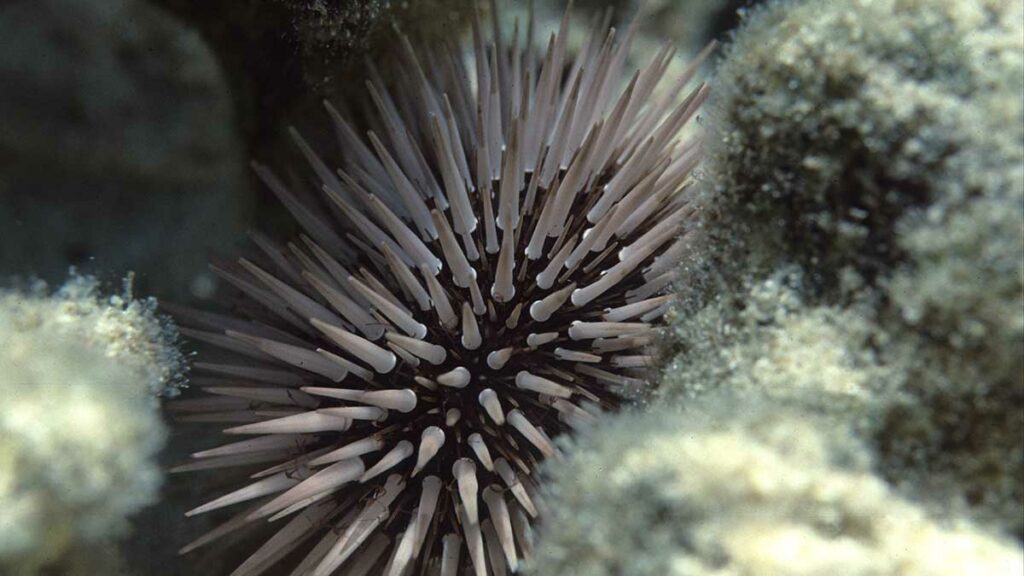
What is a sea urchin?
The Sea Urchin is a slow moving creature that feeds mainly of algae, sea weed and kelp. They move around the ocean with the help of tiny tube like feet that are almost invisible to the naked eye. Common colors they found in include black and dull shades of green, olive, brown, purple, and red.
What does a sea urchin eat?
Because its preferred source of nutrition is algae, it does have a place in a well-balanced ecosystem. However, left unchecked by predators, sea urchins can have a devastating effect on an ecosystem by obliterating macroalgae and the species that also depend on this food source to survive. Scientists call this phenomenon an “urchin barren.”
Since they prefer to live in relatively shallow coastal waters, the presence of crabs, sea otters, eels, large starfish, and sea birds can help keep populations from exploding. Sea urchins are also quite popular among sushi enthusiasts, where the roe is collected for consumption.
How sea urchins move
Although they may seem to be rooted in one spot, sea urchins are anything but sessile. They move around by way of hundreds of tiny tube feet, just like a starfish or a sand dollar. Since their mouth is located on the underside, they spend much of their time foraging along the ocean floor, consuming algae, decaying organic matter, and other little bits of food.
How sea urchins spawn
You may see urchins on the sea floor in colonies at times, and there is a very important reason for this. When sea urchins spawn, it takes place externally, in the water column. The male will first release its sperm, followed by a release of eggs by the female, and fertilization occurs when the eggs and sperm make contact. The more males and females there are in one consolidated area, the better chance there is to produce more embryos.
The origins of the sea urchin date back to about 450 million years ago, and have ever since been adapting to changing environments and conditions over eons to maintain their place in evolutionary history. For a creature that has no true brain, we have to take our hats off to the amazing capability for survival that the lowly sea urchin displays.
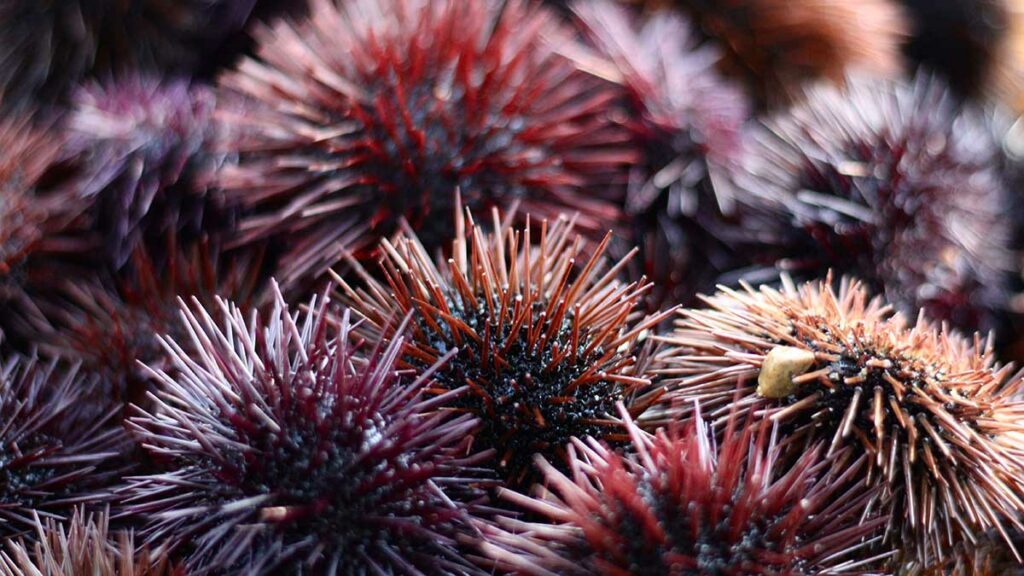
A threat to marine life
Widely found in oceans around the world, the sea urchin is actually considered a threat to marine environments, as they reproduce rapidly and can wipe out large areas of marine fauna causing barren wastelands underwater known as urchin barrens. In many countries sea otters which are a natural predator of the sea urchin have been introduced into the ecosystem just to keep the rapidly multiplying urchins in check. This has proved to be highly successful in British Columbia and in Monterrey Bay where urchin nibbling at the base of the giant kelp forest were causing large areas of kelp to get depleted.
A threat to divers
Divers are especially wary of these creatures mainly due to the fact that accidental stings while walking in a shallow reef, or touching one accidentally while scuba diving can be a painful proposition. The spines of sea urchins remain in the wound making wound heal slowly. Sea urchins inject a small amount of venom when stinging, but the amount is negligible to cause any serious injury, around 10 species of Urchins are poisonous but there are a few that are deadly. Sea urchin stings must be washed thoroughly and rinsed with vinegar to wash out the stings and then watched over the next couple of days for signs of infection. Divers should be constantly vigilant where they place their hands, to avoid an accidental encounter with these spiny devils.