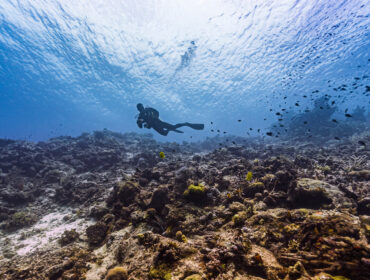
What is it about wall diving that has divers completely enthralled with the activity? The fascination for wall diving is difficult to explain, anyone who has dived a reef wall will rave about the experience and most dive operators will always feature their wall dive as one of their top dive sites and promote them excessively.

A Wall in scuba terms is essentially an underwater cliff face, more commonly a reef edge that runs vertically, usually run from shallow to deep and drops off suddenly into the depths of the ocean. Diving along this vertical reef/rock edge is known as wall diving. Most coral Islands and barrier reefs like Australia’s Great Barrier Reef and Belize’s Barrier Reef have stunning wall drop-offs teeming with coral and marine life.
So what’s all the fuss about diving along a reef cliff? Well for starters, wall diving is usually reserved for the more seasoned divers, as they can often be rather challenging to dive making them more exciting. A wall dive usually implies a deep dive, as walls drop off suddenly to great depths.

Secondly, diving along the face of a vertical wall requires good buoyancy control because there is no seabed to prevent the diver descending too deep. Constant monitoring and depth control is crucial to diving along a wall, as a diver can easily drop too deep without even realizing it as there is no sea bed as a visual indicator of depth.
Thirdly, reef walls usually have strong upward or downward currents running along the wall as the current from the deep hits the vertical rock face and rises, making it extremely challenging to navigate and swim which adds to the challenge and the difficulty for novice divers.

Fourthly, wall diving meets just about every type of diver preference from spectacular vistas, abundant marine life ranging from smaller reef fish near the top to larger pelagic fish such as Sharks, jacks, grouper and tuna around the depths. Corals grow at interesting angles creating a kind of three dimensional gardens as they struggle for light on the vertical overhangs. A wall offers a wide variety in dive profiles, exciting visual/physical sensations, and tremendous opportunities for the underwater photographer, as all sorts of fascinating creatures live along a reef wall, and if you are a macro photographer, you will have no end of interesting subjects to capture. Exploring tiny nooks, crevices to larger caves and overhangs is always interesting, and simply observing the change of marine life as you descend along a wall is a real eye-opener.
The sensation of being suspended in the ocean with only one supporting wall while all the larger fish of the ocean and their predators darting below you, will give any diver a rush.

If you’re planning to dive a wall, make sure you plan your dive well, and know the strength and direction of the currents along the wall. Plan a multi-level or profile dive to maximize your bottom time and observe the different levels of marine life as you change depths. Always remember to watch that depth gage! Wall dives are deceptively notorious for having divers drop below their limits, as currents constantly pummel divers who have no sea floor as a reference. Be mindful of the fragile coral growing along the vertical, and watch where you grab on to, as there are often several creatures hidden in the cracks and crevices along a reef wall.
Photos from flickr by: g-na, underwatertourist, Enje, Caloy and Myra


To put it in perspective, when you get your first certification to dive (Open Water Diver) the dept limit to dive is 60 feet (18 meters) whereas an Advanced Open Water diver is certified to dive to 100 feet (30 meters). Different
Under water pressure the air in a diver’s tank too gets compressed further, providing fewer “breaths” which in turn runs out a lot quicker than if you were diving at a shallower depth. This means either carrying an additional small cylinder of air called a pony bottle or having a drop tank available is advisable.


Have you ever been on a dive where you look out not too far away into the distance and see a massive shoal of barracuda’s, jacks, fusiliers or other variety of fish give you that feeling of being small and insignificant in their world? Well, that’s exactly the kind of feeling some fish off the coast of North Sulawesi would have had when they saw a slightly different although extremely large shoal of a completely different species in August this year! 2861 divers went for a 31 minute dive simultaneously off the North Sulawesi capital Manado to earn themselves a new Guinness book record. A
This couldn’t have been an easy feet and just considering the logistics of arranging such a dive would be a nightmare for even the most seasoned dive operators. A feat of this sort would involve 2,861 sets of 
Going through withdrawal symptoms waiting until your next diving trip? Can’t wait to submerge into the underwater realm? Well we have compiled a list of 
Going through withdrawal symptoms waiting until your next 
as earned him more than just bread & butter, with movies like The Abyss, Titanic, Into the Blue, Terminator or Aliens.
Jessica makes Scuba diving look sexy.
and not to mention her good friend the Mexican beauty Salma Hayek has been Scuba diving since she was 12. Then there is Metallica Drummer Lars Ulrich who is an avid scuba diver, to the extent that he has been known to read 


Contrary to popular belief, Jaws and the endless shark attack programs shown on TV, there have been very few shark attacks on Scuba divers. Let’s just say your chances of getting hit by lightning, dying of a wasp, bee or snake bite are a lot more than becoming a shark’s supper. In the United States the annual risk of death from lightning is 30 times greater than that from shark attack.
As bad as a Shark taking a nip at you may sound and with no intention of downplaying the severity of the situation, the shark attack trauma is less common than such beach-related injuries as spinal damage, dehydration, jellyfish and stingray stings and sunburn.